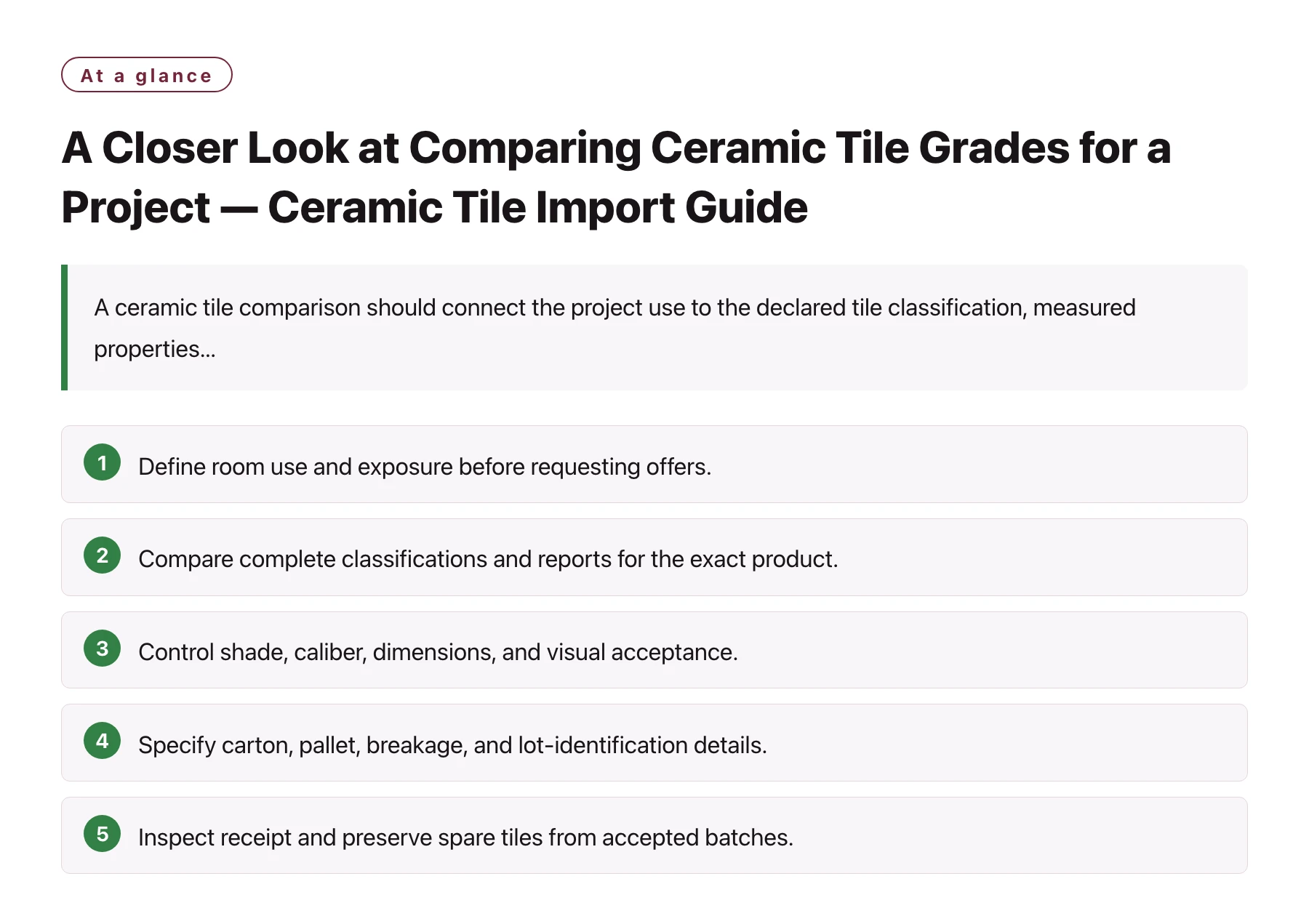
A ceramic tile comparison should connect the project use to the declared tile classification, measured properties, appearance limits, and packaging controls. Samples, catalog names, and price alone do not show whether offers are technically comparable. Specify the product and its lot identity before approving a supplier.
Key takeaways
- Define room use and exposure before requesting offers.
- Compare complete classifications and reports for the exact product.
- Control shade, caliber, dimensions, and visual acceptance.
- Specify carton, pallet, breakage, and lot-identification details.
- Inspect receipt and preserve spare tiles from accepted batches.
A tile specification should connect intended use to product evidence, lot identity, and the installation plan.
1. Start with where and how the tile will be used
List indoor or outdoor location, floor or wall, wet or dry exposure, expected traffic, cleaning method, substrate, and installation system. A hotel bathroom, retail floor, exterior facade, and decorative wall may need different properties even when the selected tile looks similar.
Identify the project designer, installer, and compliance owner. Ask each supplier to quote against the same area schedule, size, finish, thickness, edge, color, and quantity including an agreed waste allowance.
2. Compare declared classification, not sales labels
Request the complete product classification and standard edition. ISO 13006:2018 defines classifications, characteristics, and marking requirements for ceramic tiles made by normal extrusion or dry pressing, with test methods in the ISO 10545 series. Confirm that the product and accessory type fall within the cited scope. [1]
Terms such as “porcelain,” “commercial grade,” or “premium” can be used differently in sales materials. Ask suppliers to state the applicable water-absorption group or other declared class, supporting test, and product code rather than relying on marketing names.
3. Ask for the properties relevant to the design
For flooring or exposed areas, have the project team select needed performance evidence such as water absorption, breaking strength, abrasion, slip-related characteristics, frost or chemical resistance. The appropriate properties depend on application, local rules, and installation; avoid ordering a standard panel of tests without a reason.
Match every report to the exact factory, body, surface, size, and finish. A glaze or body change may affect performance. Request test method, sample identification, date, result, and limits. Ask a qualified reviewer to interpret results against the specification.
4. Review size, flatness, and visual variation
Specify nominal dimensions, thickness, warpage or flatness tolerance, squareness, edge quality, shade range, and caliber. Request multiple samples from production lots if shade or surface consistency is important. Review tiles in a representative layout and lighting, not only as a single piece.
Agree how defects such as chips, pinholes, cracks, surface marks, color variation, and edge damage are classified. Confirm accepted variation in the contract and retain a labeled reference board or sample set. Avoid approving appearance from an image alone.
5. Make packaging and lot identity part of the specification
State pieces per carton, coverage per carton, carton marks, batch, shade, caliber, factory, product code, and pallet labels. Require a packing list that reconciles cartons, quantities, and lot identifiers. Mixed batches may create visible differences or installation disruption.
Specify corner protection, dividers, moisture protection if relevant, pallet stability, stretch wrap, strapping, and handling marks. Ask for a packing sample or photos for long-distance shipment. Define the process for reporting broken cartons and shortages at receipt.
6. Estimate quantity and breakage consistently
Calculate ordered area from measured installation area and the project’s cutting pattern, layout, and agreed waste allowance. Confirm whether the price is per piece, square metre, or carton and how partial cartons are handled. Keep spare tiles from the same lot where future repairs matter.
Do not use a generic waste percentage without checking room geometry, pattern, tile size, cutting, and installer practice. Reconcile supplier coverage calculations with the designer before order placement.
7. Compare quotations on complete landed terms
Normalize product, shade, caliber, quantity, cartons, pallets, sample cost, testing, minimum order, lead time, payment, packing, freight, insurance, and delivery location. State who arranges export and import formalities under the agreed trade term and who bears each cost or risk.
Ask suppliers to list exclusions, product substitutions, sample-to-production differences, and limits on claims. Compare cost per usable installed area when carton format, breakage risk, or cutting yield varies.
8. Approve a traceable production sample
Label approved samples with manufacturer, plant, product code, body, finish, size, shade, and date. Record visual approval separately from technical acceptance. If a mockup includes grout, adhesive, or lighting, list those conditions because they influence appearance.
Require prior written approval for changes to factory, body, glaze, size, finish, carton, or production lot strategy. Specify what retesting or reapproval is needed and who can accept a deviation.
9. Plan receipt and installation checks
At receipt, verify carton condition, quantities, batch labels, shade, caliber, and visible breakage before mixing lots. Quarantine unidentified or damaged cartons and record photographs, pallet marks, and delivery documents. Coordinate the findings with the installer before opening additional boxes.
Buyers sourcing Foshan ceramic tile grades and packaging can give suppliers one project schedule and evidence checklist. Resolve mismatches before installation; keep excess tiles from accepted lots labeled for future maintenance.
Sources
Frequently asked questions
How should tile grades be compared?
Compare full classification, intended application, declared properties, test methods, dimensions, appearance, and evidence for the exact product code.
Does a tile sample prove an entire shipment matches?
No. Approve a traceable sample and specify production lot, shade, caliber, visual limits, and receipt checks.
Why do shade and caliber matter?
They help identify production variation that can affect a continuous installed surface and carton coordination.
What should a tile carton label show?
Include product code, size, shade, caliber or lot, quantity or coverage, manufacturer, and any project-required handling marks.