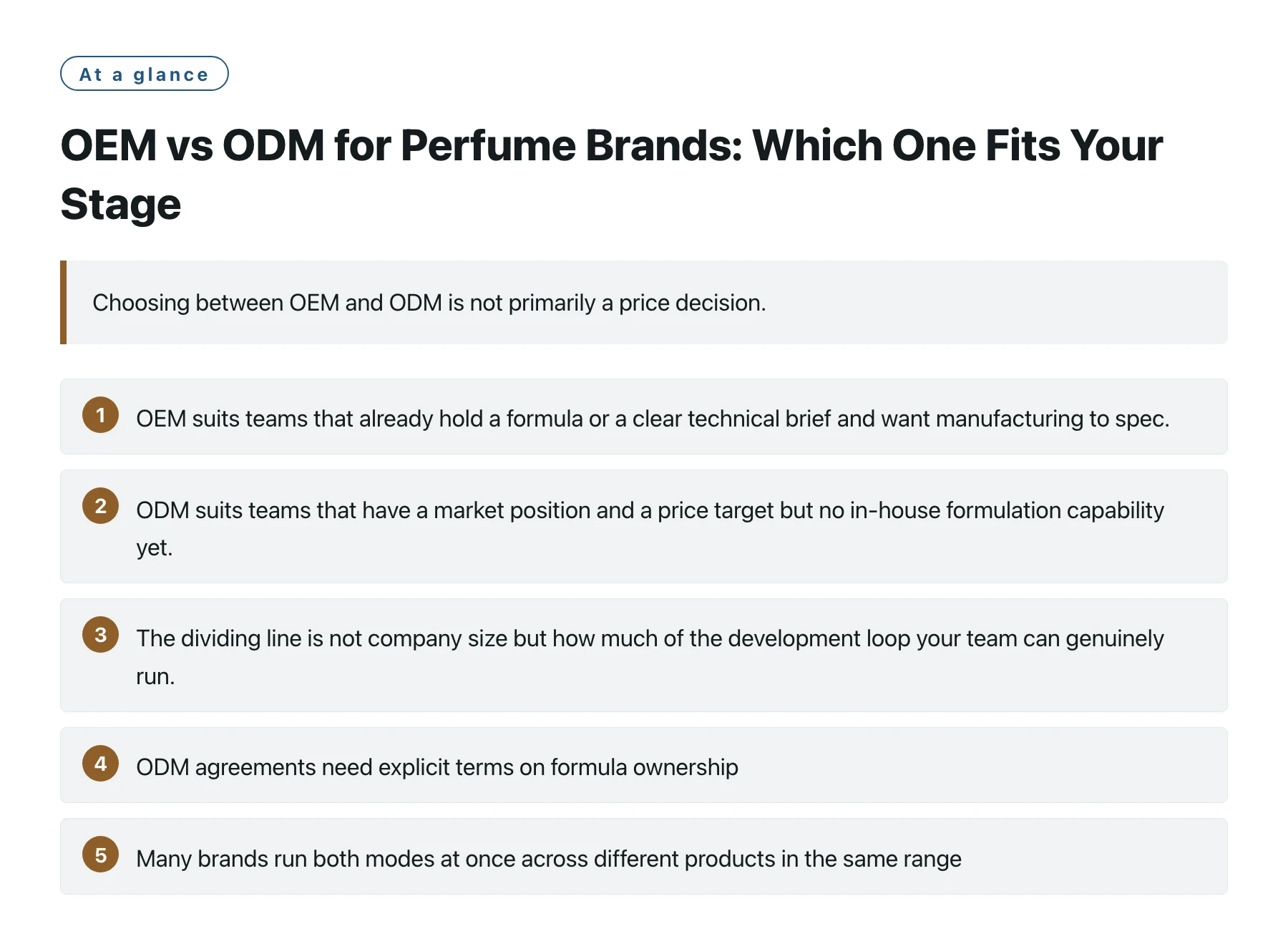
Choosing between OEM and ODM is not primarily a price decision. OEM means you bring the formula and the specification, and the factory manufactures to them. ODM means the manufacturer develops a concept that you then adapt and brand. The right answer depends on how much development capacity your team has right now, not on which mode sounds more premium. Get that mapping wrong and you will either pay for work you could have done, or ship a product you do not fully control.
Key takeaways
- OEM suits teams that already hold a formula or a clear technical brief and want manufacturing to spec.
- ODM suits teams that have a market position and a price target but no in-house formulation capability yet.
- The dividing line is not company size but how much of the development loop your team can genuinely run.
- ODM agreements need explicit terms on formula ownership, exclusivity and whether the concept can be sold to others.
- Many brands run both modes at once across different products in the same range, and that is usually sensible.
Ask ten suppliers what OEM and ODM mean and you will get roughly the same answer. Ask ten brand owners which one they should choose and the answers scatter, because the labels are being applied to a decision that is really about capability.
The confusion has a cost. A team that picks ODM expecting to influence the formula in detail ends up frustrated by a development process it does not control. A team that picks OEM without the internal skill to write a specification ends up approving something it cannot evaluate.
This article maps the two modes onto stages of brand development, identifies the clauses that matter in each, and explains why mixing them inside one range is often the most practical route.
What actually differs between the two modes
In OEM, the manufacturing partner produces to a specification you supply. You may have developed the formula yourself, licensed it, or had it developed by a third party, but at the point of production the formula and the technical decisions are yours.
In ODM, the manufacturer carries the development. The partner proposes a concept, builds the formula, often supplies the packaging direction, and then adapts it to your brand. You are buying a developed product rather than a manufacturing service against your own design.
The work moves, the accountability does not
Whichever mode you choose, the brand remains accountable to the market for what is in the bottle. ODM transfers development work, not responsibility. Recalls, mislabelling and safety claims still land on the brand whose name is on the front.
That single fact should shape the agreement. Even in a fully ODM arrangement, the brand needs visibility of the formula, the allergen declaration and the restriction headroom, because those are the things it will have to answer for.
Development effort is the real cost line
The visible price difference between the modes is smaller than most buyers expect, because both still require sampling, testing and packaging. The larger difference sits in internal hours: OEM consumes your team's development time, while ODM consumes your team's evaluation time.
If your team cannot evaluate a submission precisely, ODM becomes expensive in a different way, since you will iterate on instinct and the rounds will multiply.
Where design and concept ownership sits
ODM frequently bundles bottle selection, decoration and carton design into the offer, which is efficient and also where ownership questions begin. Design registrations and industrial designs are territorial rights, and the World Intellectual Property Organization maintains the international registration systems that brands use to secure them [1].
Before signing an ODM agreement, establish whether the packaging design is exclusive to you, whether it is registered, and who holds the registration. A design that is already in use by three other brands changes the value of the offer considerably.
Matching the mode to where your brand actually is
| Your situation | Signals it is time for this mode | What you still have to supply | Main risk to manage |
|---|---|---|---|
| First launch, no formulation capability | You have a target market and a price point but no technical brief | Positioning, price ceiling, target markets | Accepting a concept you cannot technically evaluate |
| Second or third product in a range | You know your wear profile and your customers but not the chemistry | Wear targets, cost limits, brand constraints | Concepts that do not fit the existing range |
| Brand with in-house development | You hold or license formulas and want manufacturing to spec | Full specification and reference standards | Choosing a partner whose process control is weaker than your brief |
| Scaling a proven product | The formula works and the constraint is capacity and consistency | Retained standards and tolerances | Batch-to-batch variation as volumes rise |
| Building a signature line | Scent identity is the main competitive asset | Creative direction and exclusivity terms | A concept that the manufacturer can resell |
The middle two rows are where most brands actually sit, and they are also the rows where teams argue most about which mode to use. The useful test is simple: if you can write a document that a stranger could manufacture from, you are ready for OEM. If you cannot, ODM is the honest starting point, and you should plan to move along the table as capability accumulates.
The clause that causes the most damage in ODM work is silence about exclusivity. Nothing in a standard ODM agreement prevents the same concept from being offered to another brand unless the contract says so, and by the time two similar products appear in the same market the argument is commercial rather than legal. Before you sign, get three things in writing: whether the formula is exclusive to you and for how long, who owns the packaging design and any registration covering it, and what happens to the formula if you leave. Manufacturers with a large catalogue, including Xuelei, will have standard positions on all three; the mistake is accepting them without reading them.
Why the two modes are not mutually exclusive
Brands often treat the choice as permanent. It is not. A range can carry an ODM-developed entry product alongside an OEM-manufactured signature scent, and the two can share packaging components and a supplier relationship.
There are practical reasons this works, and one common reason it goes wrong.
Different products carry different strategic weight
A travel format or a gift-set filler rarely justifies proprietary development. A signature scent that the brand expects to build on for years very often does. Spending development effort in proportion to strategic weight is a sound rule, and it naturally produces a mixed portfolio.
One relationship, several service levels
Working with a manufacturer that offers both modes keeps the supply chain simple while the service level changes per product. Fragrance houses such as Givaudan operate across creative perfumery and ingredient supply for the same reason: the commercial relationship is broader than any single brief [2].
Some houses offer both modes under one roof, which is why a conversation with a manufacturer like Xuelei Fragrance tends to start with which mode fits your team rather than with a unit price. That ordering of the questions is a reasonable sign, because the mode decision changes almost every number that follows.
The failure mode is blurred accountability
Mixing modes fails when nobody can say which document governs which product. Keep a single register that lists, per product, the mode, the formula owner, the reference standard and the exclusivity terms. It takes an afternoon to build and it answers most disputes before they start.
How to make the decision in one meeting
- Count your development hoursEstimate honestly how many internal days per month your team can give to formulation review and sampling rounds.
- Write the specification you would needDraft the document an OEM partner would require; the gaps in it tell you how much capability you are missing.
- Decide what must be exclusiveName the products where a resellable concept is unacceptable, and treat those as OEM candidates regardless of cost.
- Check the partner on both modesAsk how the same manufacturer handles OEM and ODM differently, and who signs off technical changes in each case.
- Set the review datePlan to revisit the mode when the brand launches its next product or when internal capability changes.
Sources
- WIPO — World Intellectual Property Organization —— The UN agency for intellectual property; resources on industrial design and patent protection relevant to product and packaging design.
- Givaudan —— One of the largest fragrance and flavour houses; public material on fragrance creation, ingredient portfolio and market segments.
Frequently asked questions
Is ODM cheaper than OEM for perfume?
Usually the unit price looks lower because development is spread across the manufacturer's existing catalogue, but the comparison is not like for like. OEM consumes your internal development hours, while ODM consumes evaluation hours and may limit exclusivity, so compare total cost rather than unit price.
Can I move from ODM to OEM later?
Yes, and many brands do, but only if the agreement allows it. Confirm before signing who owns the formula and whether you can take it to another manufacturer. Without that clause, moving to OEM means developing the product again from the brief.
Does ODM mean I cannot influence the fragrance?
You can usually influence it through modification rounds, but you are working from the manufacturer's starting concept rather than from your own brief. If the scent is central to your brand identity, that starting point matters more than most buyers expect.
What should an ODM contract cover?
At minimum: formula ownership and transfer, exclusivity by market and duration, packaging design ownership and any design registration, modification limits, and the documents the manufacturer will supply per batch. Those five points cover most of the disputes that arise later.
Which mode suits a brand with no technical staff?
ODM, provided you also arrange independent evaluation support. Buying a developed concept without any ability to judge it leaves the brand exposed on both fit and compliance, which is a bigger risk than paying slightly more for guided development.