Switching Pools Without Losing a Day of Credit
Moving hashrate between pools looks like a one-click decision and behaves like a small migration. At 183 TH/s the new account should credit 0.00008209 BTC a day, which is $6.95 gross and $6.67 net at BTC $84,692. Knowing that target before you flip the switch is how you tell a normal settling-in period from a configuration mistake.

Key takeaways
- A 183 TH/s account should show 0.00008209 BTC a day, or $6.95 gross, once every worker is reporting.
- PPS+ credits hourly, so a partial first day should still produce a partial payment rather than nothing.
- PPLNS credits arrive after 6 confirmations, which means the first hours on that schedule look empty by design.
- Compare the pool's reported hashrate with your own miner list before assuming the payout is wrong.
Before the switch, write down the baseline
Take a screenshot of the old account at the same hour on two consecutive days. You want the reported hashrate, the daily credit and the payout history in one frame. Without that baseline you have nothing to compare the new account against, and the first quiet hour will feel like a loss even when nothing has gone wrong.
Then calculate the target for the new account from first principles rather than from the old dashboard. Divide 450 BTC, the daily network issuance at 144 blocks of 3.125 BTC, by the 1,003 EH/s network hashrate, multiply by your own hashrate, and apply the listed rate that matches your chosen scheme. That number is the only honest expectation you will have for the first week.
What a new account actually needs
Four things have to be right before shares count: a worker name that matches the configuration file, a payout address on a chain the pool supports, a password field left as the pool requires, and a network path that is not blocked by a firewall. Most "lost" hashrate on a pool move is one of those four, and three of them are visible within minutes on the miner's own status page.
The fifth item is less obvious: the difficulty assigned to your connection. A pool sets a starting share difficulty for a new worker, and a small miner may take a while to find the first share at that level. On a 183 TH/s machine this is rarely more than a few minutes, but on a single small unit it can look like silence. Give it an hour before you start changing settings.
It also helps to repoint one machine first. Bring a single unit across, confirm that its shares appear and its credit lands, then move the rest. That sequence costs a little hashrate for an hour and saves a much more expensive mistake, because a misconfigured port on forty machines at once is a long evening of guessing.
Why the first payment can look late
PPS+ settles the block-reward component hourly against current difficulty, so the first credit should appear within the first hour or two of accepted shares. If you chose PPLNS, the schedule is different: payment follows 6 confirmations on a block and distributes your share of the last 5 difficulty rounds. A new worker has no history in that window, so the first hours are genuinely thin.
That is not a fault, it is the shape of the scheme. PPLNS pays for shares that were present when blocks were found, and a worker that joined ten minutes ago was not present for most of them. The ViaBTC Crypto Mining account page shows which scheme is active, and switching between them after the fact does not retroactively change blocks already mined.
| Days on the new account | BTC credited | USD at $84,692 | Share of a 0.05 BTC target |
|---|---|---|---|
| 7 | 0.00057463 | $48.67 | 1.15% |
| 14 | 0.00114926 | $97.32 | 2.30% |
| 21 | 0.00172389 | $146.00 | 3.45% |
| 30 | 0.00246270 | $208.57 | 4.93% |
Those figures assume continuous uptime and a constant network hashrate. Neither holds exactly, which is why the table is a checkpoint rather than a contract. Use it on day seven: if the credited total is within a few percent of 0.00057463 BTC, the migration worked. A gap of 10% or more usually means one worker never connected.
The numbers a partial month produces
Migrations rarely happen on the first of the month, so the first statement is a mixture. Say the move happens on day 11 of a 30-day month. Ten days belonged to the old pool, twenty to the new one, and the two credits together should roughly equal a full month at your hashrate minus whatever downtime the move consumed.
That framing makes a useful check possible. If the combined total for the month is lower than a single-pool month by more than the hours you spent moving, something was lost in transition. If it is close, the only cost was the downtime itself, which is usually a couple of hours at most and sometimes none if you point the backup configuration at the new pool before shutting the old one down.
Keep the two statements side by side for that month and nothing longer. Mining payouts are settled in coins, and the dollar value of a mid-month credit depends on the price on the day it arrived, not the price on the day you compare. A statement that looks 4% short in dollars may be exactly right in BTC, with the difference coming entirely from a price move between the two pools' payment dates.
The payout address is part of the setup
An address that belongs to the wrong chain will accept a transfer and never return it, and the pool cannot tell from the string which chain you meant. Copy the address from the wallet's own receive screen rather than from a message or an old note, and check the first four and last four characters after pasting. The few seconds that takes is the cheapest safety measure in the whole migration.
Then let the first credit confirm before moving the rest of the hashrate. A small balance arriving at the right address answers the question that matters, and it is much easier to correct a payout address with one machine pointed at it than with forty.
What happens to the old pool's final credit
Leaving a pool does not cancel what you already earned. Under PPS+ the last hourly settlement may land after the machines have moved, and under PPLNS the final blocks can take six confirmations before they distribute. Closing the old account on the day of the move can make those credits harder to collect, so leave it open until the balance is empty.
Check the old account once a week for a month, then once more at the end of the quarter. The amounts are small, but the habit is the same one that catches a missing worker: look at the record, not at the memory of the record.
Worked example
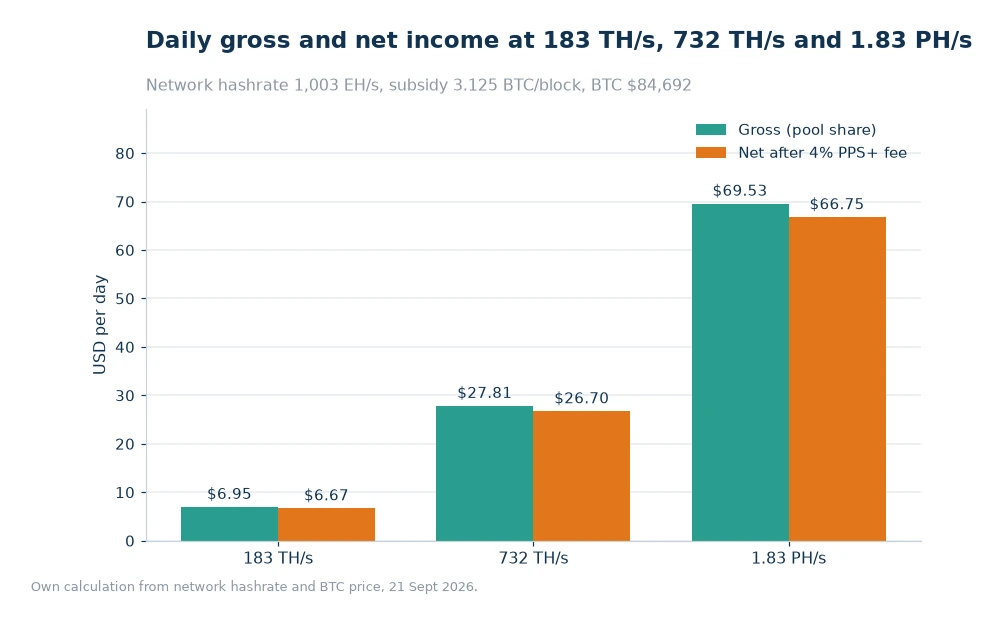
The chart uses three points that relate by simple multiples, which makes the arithmetic easy to follow.
- Start from the share of one terahash: 0.00000044865 BTC a day at 1,003 EH/s.
- At 183 TH/s: 183 × 0.00000044865 = 0.00008209 BTC a day.
- In dollars: 0.00008209 × 84,692 = $6.95 gross; after the listed 4%, $6.67.
- 732 TH/s, four machines of 183: 0.00032837 BTC, or $27.81 gross and $26.70 net.
- 1.83 PH/s, ten machines: 0.00082095 BTC, $69.53 gross and $66.75 net.
- Seven days at 183 TH/s: 7 × 0.00008209 = 0.00057463 BTC, the day-seven checkpoint in the table.
Frequently asked questions
Will I lose a full day of earnings when I switch pools?
No. PPS+ credits hourly, so shares submitted after the switch are paid in the next hourly settlement, and the only real loss is the downtime spent repointing the machines.
Why is my first PPLNS payment smaller than expected?
PPLNS distributes after 6 confirmations across the last 5 difficulty rounds, and a worker that joined recently holds only a small slice of that window.
How do I confirm every machine arrived on the new account?
Compare the total reported hashrate on the pool with your own miner list, then check that the daily credit matches 0.00008209 BTC per 183 TH/s within a few percent.
Move once, then leave the settings alone
After the first week, resist the urge to keep adjusting. Every configuration change restarts the clock on your own verification, and a pool move that is followed by three days of tinkering tells you nothing about whether the original setup was correct. Record the working configuration, keep a copy of the worker names, and treat the next month as the real measurement.
Two pages shorten the process. The Profit Calculator gives the expected daily figure at current difficulty so you do not have to do the division by hand, and the mobile app sends the alert when a worker drops off, which is the failure mode a monthly statement hides for weeks. Withdrawals from the mining balance carry no fee, so there is no reason to leave coins sitting until a threshold is met.
Sources: the pricing and pool statistics pages on viabtc.com[1]. Figures use the 21 Sept 2026 snapshot: 1,003 EH/s network, 132.76 T difficulty, 3.125 BTC subsidy, 144 blocks daily, $84,692 per BTC. Published 24 Oct 2026; totals assume uninterrupted running and a flat network.