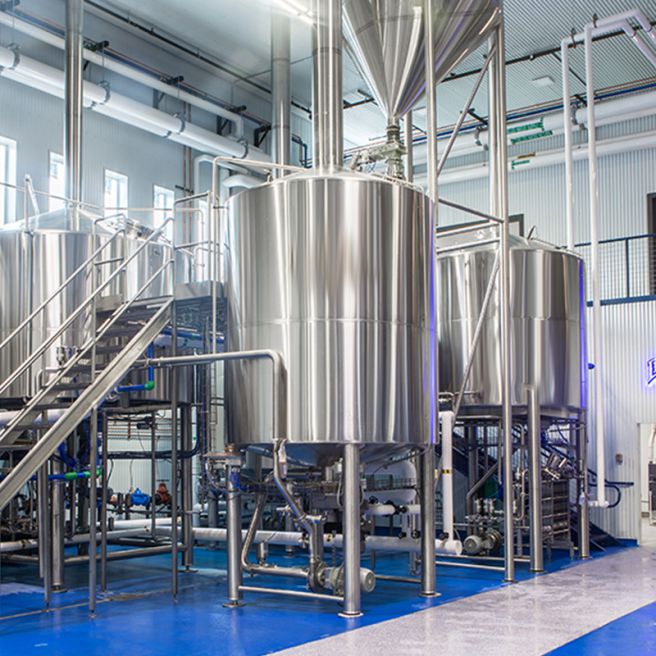
Cleaning a brewhouse starts with removing grain, hop matter, wort, protein, and mineral deposits before they dry, followed by a controlled CIP cycle matched to the vessel and soil type. A normal sequence may include a water pre-rinse, alkaline wash, intermediate rinse, periodic acid wash, final rinse, and sanitation where required. Temperature, detergent concentration, circulation time, and flow all need measurement rather than guesswork. Automated brewery CIP systems can control temperature, flow, and detergent concentration in the return line. Cleaning should also include valves, gaskets, pumps, heat exchangers, spray devices, sensors, and drains, because vessel walls are only one part of the sanitary system.
Cleaning should begin as soon as practical after wort transfer. Fresh sugars and proteins rinse away more easily than material left to dry on stainless steel, while spent grain and hop solids should be physically removed before chemical circulation. Sending large solids into a CIP loop wastes detergent, can block strainers, and reduces useful circulation through smaller pipe sections.
The first rinse is normally used to remove loose material rather than sanitize the system. Operators should watch the return water instead of relying only on a fixed timer: suspended solids, color, foam, and temperature can show whether substantial product remains. The 2022 FDA Food Code follows the same general hygiene sequence for food-contact surfaces—organic material is removed before an appropriate sanitizing step is applied.
Once loose soil is gone, the cleaning problem changes from physical removal to chemical removal. Wort leaves carbohydrates and protein on tanks and piping, while heated surfaces can develop more strongly attached deposits. Alkaline brewery detergents are commonly selected for organic soil, but the usable concentration and temperature should come from the chemical supplier and equipment manufacturer rather than a copied setting from another brewery.
More caustic does not automatically produce a cleaner vessel. A cycle with poor spray coverage or insufficient circulation can still leave residue even when chemical strength is increased.
Brewers Association guidance for draught systems provides a useful illustration of how tightly cleaning variables are specified: its published guidance calls for 2% caustic for routine line cleaning and 3% for more difficult conditions, with solution at 80–110°F and at least 15 minutes of recirculation. Those figures apply to draught lines, not as universal brewhouse CIP settings, but they show why chemical concentration should be measured rather than estimated.
Mechanical action has equal importance once a chemical wash starts. A spray device needs enough supplied flow and pressure to wet the intended tank surface, while a pipeline needs adequate circulation through every cleaning route. A vessel can complete a programmed cycle and still contain untreated areas if a spray head is partly blocked, a valve remains in the wrong position, or a branch has poor drainage.
Modern CIP equipment therefore monitors more than elapsed time. Alfa Laval brewery CIP systems, for example, can automatically control return-line temperature, flow, and detergent concentration, and its documented systems can support up to 15 individually optimized cleaning programs and flow rates up to 400 hl/h. Sani-Matic documentation describes systems capable of storing up to 40 recipes with as many as 96 programmable steps per recipe.
Those numbers also explain why one CIP recipe should not be copied across every vessel. A mash vessel carrying grain residues, a wort kettle with heat-affected deposits, and a plate heat exchanger with narrow channels do not present the same cleaning conditions. Recipe settings should reflect vessel geometry, soil type, detergent compatibility, operating temperature, and the equipment maker's limits.
Mineral deposits require another approach. Calcium-containing scale and brewery stone are inorganic, so an alkaline wash used for protein and carbohydrate soil may not remove them adequately. Periodic acid treatment is commonly incorporated after alkaline cleaning or on a separate schedule, with frequency adjusted to water chemistry, deposit formation, production volume, and inspection findings.
The Brewers Association's draught guidance, for comparison, recommends an acid treatment every 3 months in addition to routine alkaline line cleaning to remove inorganic buildup such as calcium oxalate and calcium carbonate. Brewhouse intervals can be different, but visible scale, declining heat transfer, and repeat deposits provide better reasons for changing frequency than selecting an arbitrary monthly date.
Chemical compatibility matters throughout that process. Acid and caustic products should remain separate, and chlorine-containing chemistry should only be used where the equipment and chemical instructions permit it. The Brewers Association specifically advises keeping caustic and acid separate in its draught-cleaning guidance, while its 2024 CIP safety material emphasizes the burn, corrosive-chemical, temperature, and pressure hazards involved in brewery CIP work.
For operators, PPE and chemical handling should therefore be treated as part of the cleaning procedure rather than a separate housekeeping issue. Chemical-resistant gloves, suitable eye or face protection, correctly labeled containers, controlled chemical addition, and accessible safety information reduce exposure risk. Pumps, hoses, clamps, seals, and tanks also need ratings appropriate for the temperature, pressure, and chemicals used.
With the chemistry under control, inspection should move to small components. Product can remain around valve seats, sample ports, thermowells, gasket grooves, hose fittings, instrument connections, and poorly drained branches even when large tank surfaces look clean. Elastomer gaskets should be checked for cuts, swelling, flattening, chemical attack, or loss of elasticity before those defects create spaces that retain wort.
A practical inspection can separate tasks by frequency:
-
After production: inspect visible product surfaces, remove solids, rinse vessels, check spray devices, and look for leaks.
-
Weekly: inspect accessible valve seats, clamps, hoses, strainers, pump seals, and gasket condition.
-
Monthly or by operating hours: review recurring leakage, pump noise, valve movement, sensor condition, and hard-to-see sanitary connections.
-
At the manufacturer’s interval: service pumps, verify instruments, inspect heat exchangers, and replace wear components where condition or service life requires it.
The heat exchanger deserves separate attention because its internal passages cannot be judged by looking through a manway. Brewers can compare wort inlet and outlet temperature, coolant temperature, flow, and pressure with known normal operating conditions. Alfa Laval recommends checking heat exchangers daily for changes in temperature or pressure and for external leakage, with CIP used to control fouling without routine dismantling.
A gradual change in cooling performance can come from deposits, restricted flow, utility conditions, or equipment problems, so temperature alone does not diagnose the cause. Trend data are more useful: if similar wort volume and inlet temperature repeatedly require longer cooling time, inspection can start before production is noticeably delayed.
The same principle applies to pumps. Seal leakage, abnormal vibration, cavitation noise, reduced flow, unusual motor temperature, or repeated loss of prime should be recorded when first noticed. Replacing the same seal every few months without checking alignment, suction conditions, operating pressure, dry running, or chemical compatibility only resets the maintenance clock.
When specifying or maintaining craft beer equipment, cleanability should therefore be considered alongside brewhouse capacity. Fully drainable pipe routes, accessible valves, sanitary fittings, suitable spray coverage, properly positioned sensors, and serviceable pumps reduce the amount of manual cleaning required over thousands of production cycles.
Stainless steel also needs appropriate handling. Its corrosion resistance depends on the condition of the passive surface, so carbon-steel tools, unsuitable chloride exposure, severe abrasion, or chemicals outside their recommended concentration and temperature can create surface problems. Scratches, pits, discoloration, weld defects, and persistent rough areas deserve inspection because soil is harder to remove from damaged surfaces.
A bright stainless surface is not proof of sanitation. A clean-looking tank can still contain residue inside a valve cavity, gasket groove, instrument fitting, or heat-exchanger channel.
Verification therefore comes after cleaning rather than being replaced by cleaning. Visual inspection remains useful for obvious residue, foam, scale, discoloration, and foreign matter, while breweries can add conductivity checks, chemical titration, rinse-water measurements, ATP testing, or microbiological sampling according to their quality program and product risk.
The Brewers Association recommends titration rather than visual estimation when confirming caustic strength in its line-cleaning guidance. FDA's 2022 Food Code likewise requires food-contact surfaces to be cleaned before sanitization and calls for the correct sanitizer concentration, temperature, and contact time according to the applicable requirements and registered product label.
Records make those measurements useful beyond a single cleaning cycle. A log can capture vessel ID, date, operator, chemical, measured concentration, wash temperature, circulation time, rinse condition, inspection findings, replaced parts, and abnormal observations. Ten entries showing the same leaking valve or declining cooling performance are more informative than ten separate maintenance requests with no shared history.
Useful records can be kept compact:
| Item recorded | What it helps reveal |
|---|---|
| Chemical concentration | Weak make-up, dosing errors, excessive chemical use |
| Wash temperature | Heater problems or incorrect CIP settings |
| Circulation time | Incomplete or interrupted cycles |
| Flow or return condition | Restrictions, pump problems, incorrect routing |
| Heat-exchanger temperatures | Gradual fouling or utility changes |
| Seal and gasket replacements | Repeated component wear |
| Inspection result | Areas requiring manual cleaning or repair |
Automation can improve repeatability, but it does not remove the need for inspection. Alfa Laval documents automated CIP sequences that may include an initial rinse, lye wash, intermediate rinse, acid wash, final rinse, and chemical or hot-water disinfection; solution can then be sent to drain or returned to a detergent tank for reuse where the system is designed for it.
Reuse makes measurement especially important because a returned solution does not remain identical forever. Soil accumulation, dilution, temperature loss, and chemical consumption can change cleaning performance. Conductivity or titration, together with temperature and visual condition, gives operators better information than assuming that a reused tank still contains its original working concentration.
Maintenance planning should use the same measured approach. A brewery running 2 brews per week places very different annual service hours on pumps, valves, heating surfaces, and heat exchangers than a site running 6 or 8 turns per day. Calendar-based checks can remain useful, but operating hours, number of cycles, historical failures, and inspection condition give a better basis for replacing wear parts.
Good spare-parts planning follows from that history. Pump seals, commonly used gaskets, valve seats, clamps, sensor seals, and other repeatedly serviced components can be kept on hand in quantities that reflect actual replacement frequency. Equipment that has run for several years may also need more frequent inspection than a recently commissioned system even when both follow the same daily cleaning procedure.
A brewhouse is therefore maintained through repeated measurements rather than one large annual service. Cleaning data show whether soil is being removed; temperature and flow records show whether process equipment is behaving normally; inspection finds physical wear; maintenance history shows whether the same component is failing again. A CIP cycle is complete only when the required conditions were reached and the result has been checked.